


Revolutionary Struggle (Επαναστατικός Αγώνας)
- Christos Bekas Moraris
- Feb 27
- 15 min read
Introduction & History
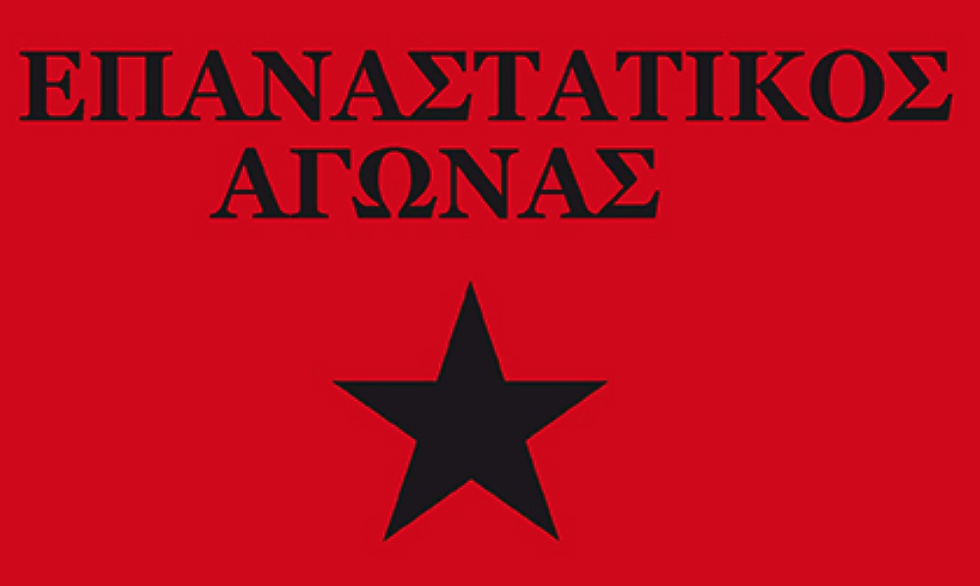
The dismantling of Greece’s primary, far-left terrorist organisation 17 November (17N) didn’t demoralise successors; rather, it created a power vacuum that new urban guerrilla groups attempted to fill and an upsurge in, and intensification of, revolutionary violence. (1) The case examined in this article, the currently inactive Revolutionary Struggle (RS), were the first to pick up the baton of violence from 17N before the latter’s trial had come to an end in 2003. (2) They stayed active until 2014. Their first manifesto was published in the Greek satirical outlet “To Pontiki” in 2004, in which they condemned the optics and ethics of 17N’s trial, described the world as having entered a new, post 9/11, “global war” era, and condemned globalisation as it promotes social exclusion and poverty. (3) As such, their motives have been cited as largely ideological, best described as attempting to promote social revolution in Greece and beyond.
As an anarchist, non-hierarchical organisation, key members include Nikos Maziotis, Panagiota (Pola) Roupa and Kostas Gournas. The RS ran an urban guerrilla campaign since 2003, using bombings and shootings against the Greek state and economic targets, including a 2009 Athens Stock Exchange bombing and a 2009 shooting that wounded a policeman. They also hit high-profile international symbols, most notably firing a rocket-propelled grenade at the U.S. Embassy in Athens in January 2007 and carried out three different attacks on Citibank in Athens. During Greece’s austerity era, they claimed a large car bomb targeting the Bank of Greece (and the IMF office housed there) in April 2014, presenting it as an anti-austerity escalation and proof they were still active.
A break in the investigations came in March 2010, when a suspected member, Lambros Foundas, was killed by police during an attempted car theft. Investigators then used evidence from his devices to identify suspects. In April 2010, Greek counter-terrorism police carried out raids that arrested core suspects, uncovered forged IDs and located a major weapons & explosives cache (including an RPG-7) tied to RS operations. Two principal fugitives were caught later: Nikos Maziotis after a central Athens shootout in July 2014, and Pola Roupa in January 2017, arrested in a small apartment where she was hiding with her child. Her arrest was the final nail in the coffin of RS’s activities. (4)
Timeline of Actions

Greek Terrorism in the Context of the State
An important caveat when examining terrorism in Greece is the state’s perception of it and the influence said perception exerts. Greece has a legacy favouring the victors (the right) and discriminating against the vanquished (the left) since the post-WW2 Greek Civil War. This discrimination was enforced through what became known as the ‘paraconstitution’, a set of emergency laws (modelled on US anti-Communist legislation) and political control techniques (used extensively in America during the Truman–McCarthy era) aimed at the political and economic exclusion of the Greek left and the consolidation of the anti-communist state. (5)
The terrorist organisation 17N (17th of November / 17 Νοέμβρη) had targeted the Greek state since the fall of the Junta and the beginning of the Metapolitefsi era in 1975 (Greece’s transition from a 7-year authoritarian rule to a multi-party democracy). So, far-left extremism ended up being the reason the state adopted a coherent counterterrorism legal framework. 17N operated from 1975 to 2001, murdered over 20 high-profile individuals, positioned themselves as vanguards of the working class, while being fanatically nationalistic, anti-Greek establishment, anti-Junta, anti-American, anti-Turkey and anti-NATO; they were committed to removing US bases from Greek soil, the Turkish military presence from Cyprus, and to severing Greece’s ties to NATO and the European Union. (6) The target audience of their terror was evidently the Greek state, while they sought to win public support. Their arrest left a gap that the Revolutionary Struggle (RS), the Conspiracy of Cells of Fire (CCF) and the Group of Revolutionary Fighters (GLF) attempted to fill with similar anti-West ideology, but with limited success due to inter-group disagreements. (7)
These far-left groups are accurately classified as homegrown terrorism and targeted under Greece’s law L.2928/2001 (a year before 17N’s arrest) and are also subject to 187A of the penal code. (8) Under Greek penal code, “The mens rea element of a terrorist activity requires that the act is committed in such a way, to such an extent or under such conditions, that it is possible to seriously harm a country or an international organization, along with the purpose of seriously intimidating a population or illegally forcing a public authority or an international organization to perform or to abstain from performing an action or with the purpose of seriously harming or destroying the fundamental constitutional, political, and economic structures of a country or of an international organization.” (9) Consistently, the Greek far-left extremists have not been treated as entities above the law.
In contrast, far-right extremist organisations and the Greek state are found to coincide. Until the murder of far-left musician Pavlos Fyssas by Golden Dawn members in 2013 (a far-right, Nazi organisation), the Greek judiciary system, cited as being the crux of the issue, was found to not only avoid prosecuting far-right extremists but also reinforce and propagate their ideology. (10) Additionally, in 2012, over 50% of the Greek police force voted for Golden Dawn. (11) The Greek security apparatus has been cited, by both reports and numerous Greek officials, to, on the one hand, conduct defiance, indiscipline, arbitrariness and abuse of authority, and on the other, activate a form of fraternal solidarity when criminal behaviour is practised. (12) During 2016-2020, the period of gradual criminalisation of Golden Dawn, Greece experienced much more far-right violence than any other country in Western Europe, with the least amount of “lone-actors”, and serious acts of violence were directed mostly against migrants and refugees, or against political opponents. (13) As such, the Greek state is co-existing with a deep-state of far-right extremists, that operate above the law and are favoured by a judicial system that reinforces their ideology and enforces terrorism laws only against what is perceived as far-left organisations.
The above indicates a highly likely binary bias in the Greek state’s perception of terrorism; Motives are prone to be bundled up under the same umbrella of adjacent far-left communities, often linked to the country’s web of social and economic problems, and ideological nuances or disagreements between members may be disregarded. Europol’s TE-SAT (2010) reads that “Left-wing terrorist groups, such as Epanastatikos Agonas (RS), seek to change the entire political, social and economic system of a state according to an extremist left-wing model. Their ideology is often Marxist-Leninist.” […] “Not all Member States distinguish between activities of left-wing and anarchist terrorist groups in their contributions. For this reason, both categories are discussed in the same chapter of this report.” (14)
Academic work on Greek counterterrorism argues that terrorism was belatedly securitised: the Greek state’s prior “erroneous belief” that domestic terrorism was not a direct security threat delayed decisive action, while later securitisation enabled arrests and policy shifts. (15) Further analyses of Greek political violence emphasise that stereotypes, especially treating terrorism as mere criminality and as an “aberration”, have been politically convenient, avoiding deeper engagement with grievances, state violence, or socio-political context. (16) As such, RS’s labelling by the Greek state encourages a de-contextualised categorisation that uses lineage simplifications (offshoot/splinter), rather than careful differentiation between Marxist-Leninist traditions mixed with nationalism (17N), anarchist-insurrectionist currents (CCF), and RS’s own hybridised anti-imperialist framing.
Objectives & Ideology
The initial manifesto of RS had a broader, international scope, while their later declarations appear to narrow into the domestic context. (17) The following is an attempt to distil the first RS manifesto and its subsequent 2006-2009 declarations in the same satirical outlet into seven central ideological themes. (18) There was no consistent theme of nationalism or national interest found, in contrast to 17N’s manifesto.
The Global-War Era: The US’s “war on terrorism” is framed as a war by a transnational political & economic elite to enforce a neoliberal “New World Order.” The RS linked the era to the wars in Iraq and Afghanistan, the Israel & Palestine wars, the NATO strategy, and several expanded post 9-11 “anti-terror” laws.
Poverty & Exclusion in the age of Globalisation: The manifesto argues that globalisation and IMF policies create mass poverty, social exclusion, and instability, claiming the ruling response is increased coercion and surveillance, coordinated through NATO and EU policing, and judicial cooperation through Europol, Eurojust, etc.
Greece’s role in imperial wars and security architecture: It claims the Greek state participates materially, through bases, airspace, logistics, and deployments. It highlights the Olympics-era security in 2004 as part of a broader international security project.
An overall “counter-revolutionary” reading of Greek history: The RS presented modern Greek state-building as one rooted in the suppression of popular social revolutionary aims (which is a strongly ideological reinterpretation of 1821 and later eras).
Anti-terror laws framing as a blurring weapon: It warns that definitions of “terrorism” expand to include sympathisers and support networks, threatening solidarity politics. In the Greek society context, solidarity politics involve any amalgam of far left and/or anarchist sympathisers who may comprise adjacent ideological communities, participate in overlapping activities such as rallies, but are not insurgents or terrorists.
Positioning of the Revolutionary Struggle Organisation: The manifesto tries to frame the RS as a continuation of armed resistance in a new era (“post-17N”, which in turn implies a power vacuum ought to be filled), albeit sporadically, with a global anti-imperialist framing.
Call to Revolution & Offensive Action: The RS explicitly rejects peaceful solutions as illusions. It calls for direct attacks on institutions of capitalism and state power and for shifting fear “into the system.” It finally presents armed struggle as part of raising consciousness and creating conditions for a broader revolutionary conflict.
Political & Military Capabilities
Continuing the tradition of 17N, the RS had the organisation of a small, clandestine, urban & guerrilla warfare unit, deploying a small group of dedicated militants. Naturally organised through each militant’s skillset, the RS had a dedicated guerrilla member, Maziotis, and a dedicated ideologue member, his partner Pola Roupa. (19) “Roupa,” a high-level security source in Athens, said: “talks the revolutionary talk as evidenced from her regular online posts on Athens Indymedia, but it was Maziotis who walked the walk. It was his fanatical determination to remain relevant, to raise the stakes, it was his ambition for the group to stand alongside 17N in the Greek pantheon of great revolutionary forces that kept RS going.” (20) The same author later echoes: Roupa may be the group’s chief ideologue, talking the revolutionary talk as evidenced from her regular posts, but it was Maziotis who walked the guerrilla walk. (21)

Operationally, the group demonstrated capacity for (1) sophisticated improvised explosive devices (IED) timing intended to target first responders, (2) small-arms ambushes, and (3) heavier weapon use, including an RPG-7 attack on the U.S. Embassy, possibly inspired by 17N’s second period in the 1980s, which saw the introduction of bombs and explosives. (22) Police raids associated with the 2010 crackdown reportedly recovered a substantial weapons cache, including the RPG-7 believed linked to the 2007 embassy attack, consistent with an urban safehouse strategy. (23)
Alleged arms-market links
An EU Parliament research briefing notes “rumours” that RS and CCF purchased weapons from Albanian organised crime groups, explicitly cautioning that there was “no hard evidence” of convergence in that discussion. (24) Such material is best treated at the hypothesis level.
Modus Operandi: The Operational Cycle
First, the organisation would select a symbol that matched its stated ideological objectives outlined in the previous section. Second, they’d attack the symbol in a high-profile manner that aimed to attract as much attention as possible. Third, they claimed responsibility for their actions, to seize control of the narrative and manage publicity, through extended ideological texts. Lastly, between attacks, they’d reinforce their previous statements, claiming continuity and status in the “Greek armed resistance lineage”.

For example, in September 2003, they chose the Evelpidon courthouse, symbolically tied to the state’s coercive & judicial apparatus and timed the attack alongside the ongoing 17N trial. They carried out a highly visible attack that Kassimeris describes as intended to hit responding police, forcing attention onto the group. (25) From there, they repeatedly picked Western symbols and struck them in ways designed for maximum visibility, most famously the rocket attack on the U.S. Embassy (2007) and later the car bomb at the Athens Stock Exchange (2009), then followed by issuing claims and framing texts to control interpretation and justify escalation. (26) The propaganda step is structural: after early attacks they circulated long manifesto-style communiqués (e.g., “New World Order or the Terrorism International”), and during their attempted resurgence they paired the 2014 Bank of Greece car-bombing with a lengthy declaration, explicitly threatening the “IMF/ECB/EU troika,” reinforcing the idea that messaging and status-building were part of the operation. (27)
Relations, Alliances, and Possible State Bias
17N and RS
RS’s debut and early communication strategy tracked the 17N “media ritual” of long ideological texts and claims of responsibility. Contemporary analyses describe RS as “pick[ing] up the baton” in the post-17N period, and several institutional descriptions added RS to lists in language suggesting a “splinter” or “offshoot.” (28) However, the link between 17N and RS is strongest in style, framing and symbolism rather than in documentary-proven organisational continuity. Both 17N and RS were secretive, but 17N was a far-left, nationalist organisation, which had Alexandros Giotopoulos as a de facto leader and Dimitris Koufontinas as a primary recruiter and operational leader. The RS lacks any mention of substantial patriotism or nationalism and functioned in an anarchical manner, streamlined with their ideology. In practice, RS was treated by authorities and media as the most serious domestic threat “since” 17N, reinforcing the succession narrative even when reporting simultaneously stressed domestic and local organisation.
Embeddedness in Anarchism
RS repeatedly used sympathetic or anti‑establishment publication channels, most notably To Pontiki (for claims and political texts) and later anarchist web platforms (Athens Indymedia). Reuters reporting on the 2014 car bomb claim located RS’s statement on an “anti‑establishment website,” illustrating a persistent relationship with movement‑adjacent media infrastructures rather than a formal political wing. (29) In this Greek context, cooperation often takes the form of shared prisoner support, propaganda amplification, or logistics via personal networks, rather than durable inter‑group mergers.
Operational Cooperation with CCF
The clearest open-source indication of operational convergence is the 2016 attempted helicopter escape aimed at freeing Maziotis as well as “other political prisoners.” Reporting in Kathimerini and eKathimerini describes Roupa’s own account on Indymedia that the plan was political, encompassed additional prisoners, and that she would not have hired a large helicopter if she intended only to free her partner. (30) Separate Kathimerini reporting further states that Roupa later acknowledged allocating robbery proceeds toward organising an escape plan that included members of CCF held at Korydallos. (31) These accounts point to opportunistic, prison-based coalitions: alliances driven by likely shared prisoner identity, collective campaigns, and common antagonism to high-security prisons, rather than by a strategic and unified operational programme.
Relations with other Greek armed groups
Europol’s TE-SAT reporting situates RS among multiple left-wing & anarchist organisations active in the late 2000s (e.g., Sect of Revolutionaries and OPLA). Notably, TE-SAT 2010 records that a 2009 murder by the Sect of Revolutionaries targeted a police officer guarding a witness in a case “against Epanastatikos Agonas,” (RS). The report reads “Sekta Epanastaton appeared for the first time in 2009 and claimed responsibility for an attack on 16 June 2009, in which a police officer was killed while on duty guarding the house of a witness involved in an investigation against Epanastatikos Agonas. The latter claimed responsibility for an attack on police officers on duty at the Ministry of Culture in Athens in January 2009. The attackers opened fire and threw a hand grenade, seriously injuring one officer. (32) Indicating an ecosystem where groups’ activities intersected through investigations, retaliation narratives, and competition for “armed struggle” status. This illustrates how state investigations can create indirect relational ties: one group’s targets and motives may be shaped by another group’s legal exposure.
Specifically, a mainstream Greek outlet reported that Koufontinas (17N) and Maziotis shared the same cell in Domokos prison and that Maziotis joined a hunger strike “in support” of Koufontinas. The report states Maziotis “was until recently” one of Koufontinas’ cellmates. (33) Co-authored protest letters have also been published. A Greek news report states Koufontinas (17N) and Gournas (former RS member) jointly sent a letter condemning “high-security prisons,” characterising them as “Greek Guantánamo.” (34)

Greek media reported that Maziotis was attacked by fellow inmates and stabbed in Korydallos, prompting an official preliminary inquiry by the Justice Ministry’s anti-crime policy secretary. In the initial reporting of the incident, Maziotis referred to his assailants as Albanians, and he was saved by Turkish and Kurdish inmates. (35) After this, CCF members, brothers Tsakalotos, accused him in a joint statement released from prison, of “informant behaviour”, as he was “photographing” the assailants by mentioning their ethnicity, thus going against the prison code and providing the Greek state with vital information. The brothers made further references to his megalomania and bruised ego, mentioning his need for psychiatric help, but refused to elaborate further. (36) Their assessment is parallel to the high-level security officials, who stated that it is Maziotis’ drive to remain relevant that is the fuel of RS. As such, any attribution of RS motives to ideology is fickle, since the RS lacks the ideological spine of 17N and CCF, and Maziotis is at odds with the rest of the “far-left” community the Greek state uses as a blanket term.
Current Status
Open sources strongly support the assessment that RS is presently inactive as an organisation with a coherent operational capability. Since their core members got arrested, there have been no widely accepted, credible claims of RS attacks after the mid‑2010s, and institutional reporting focuses on other anarchist/left‑wing cells rather than RS. Europol TE‑SAT 2025 describes Greece’s 2024 left‑wing/anarchist arrests and incidents in terms of newly established cells and contemporary propaganda themes, with no indication that RS itself is operationally active. (37)
Pola Roupa: eKathimerini reports that Roupa received conditional release on 17 November 2023 (mother of an underage child), with her sentence reduced in earlier proceedings related to the 2014 Bank of Greece bombing case. (38)
Nikos Maziotis: Greek mainstream reporting (in.gr) documents repeated parole denials (sixth rejection reported in winter 2025), including quoted reasoning referencing “lack of moral improvement” and continued political self‑identification. (39)
Residual capability: Legacy arsenals
Even if RS is inactive, legacy material and know-how can persist in milieus. In November 2024, eKathimerini reported the discovery of a long‑rented arms cache (rented since 2008) that police believed could be linked to groups active in the late 2000s and early 2010s, explicitly naming RS, CCF and others as possible historical referents. (40) Therefore, successor groups (or unaffiliated actors) are more likely to hoard old, dormant stockpiles and use them in future actions, rather than RS reconstituting as an organisation.
Successor‑group Dynamics
Reuters reporting in April 2025 on a previously unknown urban guerrilla group noted Greek police were examining the claim “without ruling out links with groups active in the past.” (41) This reflects (a) a continuing “scene” from which new terrorist cells can emerge; and (b) the established, state-sponsored attributional habit of treating new incidents as potentially genealogically connected to older organisations such as RS, with all the biases this conceptualisation involves.
Works Cited
(1) - Kassimeris, “Greece’s Terrorism Problem: A Reassessment.” (2015)
(2) - Kassimeris, “Greece’s New Generation of Terrorists: The Revolutionary Struggle.” (2011)
(3) - Athens Indymedia, “Post 635625,” accessed February 16, 2026, https://athens.indymedia.org/post/635625/.
(4) - Kassimeris, “Greece’s Ulrike Meinhof: Pola Roupa and the Revolutionary Struggle.” (2019)
(5) - Minas Samatas, “Greek McCarthyism: A Comparative Assessment of Greek Post–Civil War Repressive Anticommunism and the U.S. Truman–McCarthy Era,” Journal of the Hellenic Diaspora 13, nos. 3–4 (Fall–Winter 1986): 5–75, accessed February 17, 2026, https://www.semanticscholar.org/paper/Greek-McCarthyism%3A-A-Comparative-Assessment-of-War-Samatas/951c45abaff529c5384cf00e3b337a13739d5cd1. and George Kassimeris, “Greece: The Persistence of Political Terrorism,” International Affairs 89, no. 1 (January 2013): 131–142, https://doi.org/10.1111/1468-2346.12008.
(6) - Kassimeris, “Europe’s Last Red Terrorists: The Revolutionary Organization 17 November, 1975-2000.” (2001)
(7) - Kassimeris, (2015)
(8) - Banoutsos, “ANTI-TERROR LEGISLATION IN GREECE.” (2007),
(9) - Chainoglou, “Counterterrorism Policy and Legislation in Greece.” (2017)
(10) - Dimitris Christopoulos, Dimitris Kousouris, Dimosthenis Papadatos-Anagnostopoulos, Clio Papapantoleon, and Alexandros Sakelariou, Mapping Ultra-Right Extremism, Xenophobia and Racism within the Greek State Apparatus, ed. Dimitris Christopoulos (Brussels: Rosa-Luxemburg-Stiftung, March 2014), PDF, accessed February 16, 2026, https://rosalux.nyc/wp-content/uploads/2021/08/rightwing_a4_web16.pdf.
(11) - Β. Γ. Λαμπρόπουλος, “Άνω του 50% των αστυνομικών ψήφισε Χρυσή Αυγή!,” Το Βήμα, May 26, 2014, https://www.tovima.gr/2014/05/26/society/anw-toy-50-twn-astynomikwn-psifise-xrysi-aygi/.
(12) - Christopoulos et al., Mapping Ultra-Right Extremism, p. 26-27.
(13) - Jupskås and Fielitz, “Far-Right Violence in Greece in Comparative Perspective.” (2022)
(14) - Europol, TE-SAT 2010: EU Terrorism Situation and Trend Report (The Hague: European Police Office, 2010), https://www.europol.europa.eu/cms/sites/default/files/documents/tesat2010_1.pdf.
(15) - Karyotis, “Securitization of Greek Terrorism and Arrest of the `Revolutionary Organization November 17’.”
(16) - George Kassimeris, “Greece: The Persistence of Political Terrorism.” (2013), p. 136-137
(17) - Georgia Chantzi, The Evolution of Terrorism in Greece: From 1975 to 2009, Research Paper no. 158 (Athens: Research Institute for European and American Studies [RIEAS], March 2012), PDF https://www.files.ethz.ch/isn/139892/rieas158.pdf.
(18) - Athens Indymedia, “Post 635625”, https://athens.indymedia.org/post/635625/
(19) - Το Ποντίκι Web, “«Ο αγώνας συνεχίζεται»-Πολιτικό μανιφέστο από Ρούπα-Μαζιώτη ενώπιον του Εφετείου,” Το Ποντίκι (topontiki.gr), January 17, 2017, https://www.topontiki.gr/2017/01/17/ο-αγώνας-συνεχίζεται-πολιτικό-μανι/.
(20) - Kassimeris, “Greece’s Terrorism Problem: A Reassessment.” (2015)
(21) - Kassimeris, “Greece’s Ulrike Meinhof: Pola Roupa and the Revolutionary Struggle.” (2019)
(22) - Sotirios Karampampas, “How Has the Phenomenon of Revolutionary Groups Been Resilient in Greece? A Relational Study of Two Contentious Episodes (1965–2002)” (PhD diss., University of Sheffield, December 2017), https://etheses.whiterose.ac.uk/id/eprint/21916/1/How%20Has%20the%20Phenomenon%20of%20Revolutionary%20Groups%20Been%20Resilient%20in%20Greece%20-%20S%20Karampampas.pdf.
(23) - Newsroom, “Group’s Weapons Cache Found,” Kathimerini (eKathimerini), April 21, 2010, https://www.ekathimerini.com/news/68301/group-s-weapons-cache-found/.
(24) - European Parliament, Directorate-General for Internal Policies, Europe’s Crime-Terror Nexus: Links between Terrorist and Organised Crime Groups in the European Union (Brussels: European Parliament, 2012), [page number], https://www.europarl.europa.eu/document/activities/cont/201211/20121127ATT56707/20121127ATT56707EN.pdf.
(25) - Kassimeris, “Greece’s New Generation of Terrorists: The Revolutionary Struggle.” (2011)
(26) - Karolos Grohmann, “Suspected Greek Militants Fire Rocket at U.S. Embassy,” Reuters, August 9, 2007, https://www.reuters.com/article/world/uk/suspected-greek-militants-fire-rocket-at-us-embassy-idUSL12417386/. and Reuters, “Greek Leftist Guerrillas Claim U.S. Embassy Attack,” Reuters, August 9, 2007, https://www.reuters.com/article/us-greece-attack/greek-leftist-guerrillas-claim-u-s-embassy-attack-idUSL2438467920070124/.
(27) - Reuters, “Guerrilla Group Says It Carried Out Greek Central Bank Bombing,” Reuters, April 25, 2014, https://www.reuters.com/article/world/guerrilla-group-says-it-carried-out-greek-central-bank-bombing-idUSBREA3O1DC/.
(28) - George Kassimeris, “Greece: The Persistence of Political Terrorism,” (2013)
(29) - Reuters, “Guerrilla Group Says It Carried Out Greek Central Bank Bombing,” (2014)
(30) - Newsroom, “Fugitive Terrorist Describes Failed Prison Break” (2016)
(31) - Newsroom, “Αποφυλακίστηκε Η Πόλα Ρούπα.” (2023)
(32) - Europol, TE-SAT 2010: EU Terrorism Situation and Trend Report (The Hague: European Police Office, 2010), https://www.europol.europa.eu/cms/sites/default/files/documents/tesat2010_1.pdf.
(33) - "Κουφοντίνας: απεργία πείνας από συγκρατούμενους του για συμπαράσταση" [Koufontinas: Hunger strike by his fellow inmates in solidarity], Antenna.gr, January 27, 2021, https://www.antenna.gr/Society/article/4/593672/koyfontinas-apergia-peinas-apo-sygkratoymenoys-toy-gia-symparastasi.
(34) - TheTOC Team, "Επιστολή Κουφοντίνα - Γουρνά με αιχμές για ελληνικά... Γκουαντάναμο" [Letter from Koufontinas - Gournas with barbs about Greek... Guantanamo], TheTOC, March 28, 2014, https://www.thetoc.gr/koinwnia/article/epistoli-koufontina-gourna-me-aixmes-gia-ellinika-gkouantanamo.
(35) - LiFO Newsroom, "Κρατούμενοι μαχαίρωσαν τον Μαζιώτη στο κελί του στον Κορυδαλλό - Προκαταρκτική εξέταση," LiFO, December 22, 2017, https://www.lifo.gr/now/greece/kratoymenoi-mahairosan-ton-mazioti-sto-keli-toy-ston-korydallo-prokatarktiki-exetasi.
(36) - Gerasimos Tsakalos and Christos Tsakalos, "ΣΠΦ κατά Μαζιώτη: «Μεγαλομανής και καταδότης»," The Press Project, December 23, 2017, https://thepressproject.gr/spf-kata-mazioti-megalomanis-kai-katadotis.
(37) - Europol, EU Terrorism Situation and Trend Report (TE-SAT) 2025 (The Hague: European Union Agency for Law Enforcement Cooperation, 2025), https://www.europol.europa.eu/cms/sites/default/files/documents/EU_TE-SAT_2025.pdf.
(38) - Newsroom, “Αποφυλακίστηκε Η Πόλα Ρούπα.” (2023)
(39) - Μαλλιαρού, “Νίκος Μαζιώτης: Απορρίφθηκε Για Έκτη Φορά Το Αίτημα Αποφυλάκισης Υπό Όρους – Η Επιστολή Του Από Τις Φυλακές Δομοκού.”
(40) - Souliotis, “Arms Bust Linked to Past Guerrilla Groups.” (November 21, 2024) https://www.ekathimerini.com/news/1254022/arms-bust-linked-to-past-guerrilla-groups/
(41) - "Greek Urban Guerrilla Group Claims Attack on Hellenic Train," Reuters, April 14, 2025, https://www.reuters.com/world/europe/greek-urban-guerrilla-group-claims-attack-hellenic-train-2025-04-14/.


Comments